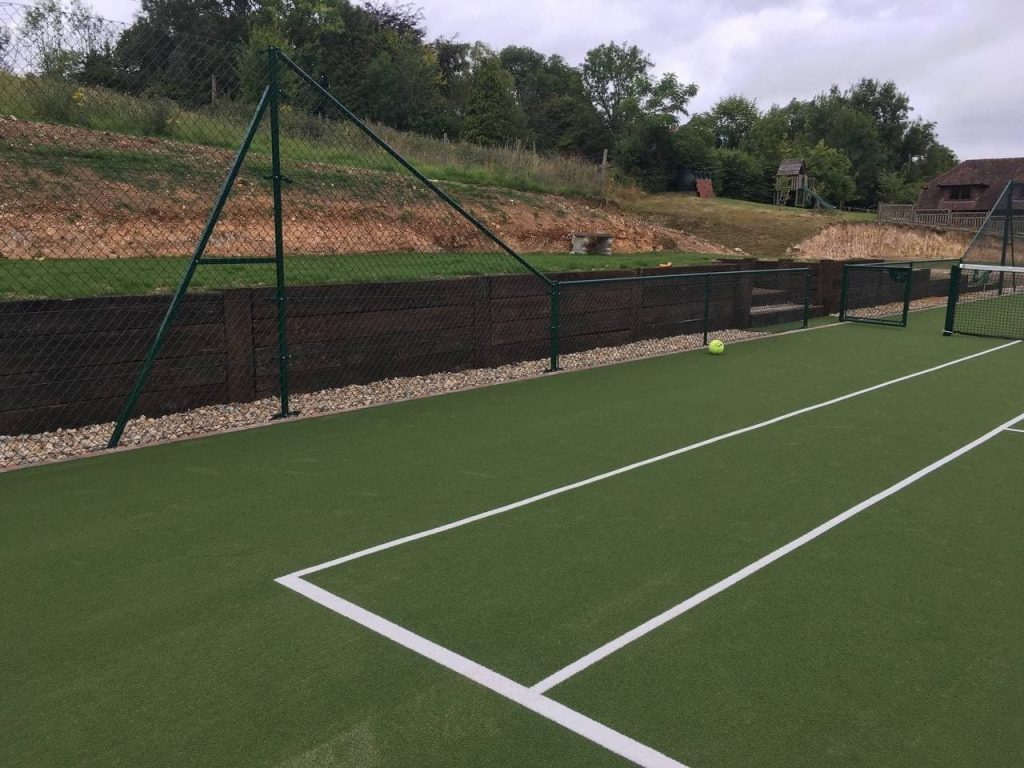
A worn or damaged tennis court does not always require complete reconstruction. Surface cleaning, crack repairs, recoating or targeted refurbishment may restore a court when the underlying construction remains stable. However, these treatments cannot provide a lasting solution when deterioration extends into the foundations, drainage system or surrounding structure.
Full tennis court reconstruction becomes necessary when the existing court can no longer offer a stable, well-drained and consistent playing surface. A professional assessment is therefore essential before deciding whether to repair, resurface or rebuild the facility.
Signs That a Tennis Court May Need Complete Reconstruction
The decision should be based on the condition of the entire court system rather than its appearance alone. The surface, base, drainage, edging and surrounding ground all influence how reliably the court performs.
Widespread or Recurring Cracking
Individual surface cracks can often be repaired when they are shallow and localised. Concern arises when cracks extend across substantial areas, repeatedly return after treatment or form an interconnected pattern.
Recurring cracks frequently indicate movement or deterioration beneath the playing surface. Filling them may improve the court temporarily, but the defects are likely to reappear unless the unstable layers are properly addressed.
Significant Movement Within the Base
The base provides the level and structural support required for consistent play. If it has weakened, shifted or settled unevenly, the court may develop depressions, raised sections and changes in gradient.
Visible symptoms can include:
- Uneven ball bounce
- Sunken or raised areas
- Cracks that reopen after repair
- Surface movement near court edges
- Noticeable changes in level
- Water collecting in several locations
Where these problems affect large sections, reconstruction may be more appropriate than repeated surface repairs.
Persistent Drainage Problems
A tennis court must shed water efficiently. Standing water can interrupt use, encourage organic growth and accelerate the deterioration of the playing surface.
Localised ponding may sometimes be corrected through targeted work. However, widespread water retention can indicate unsuitable falls, a failed drainage system or an impermeable and unstable base. Rebuilding the affected layers allows drainage and court levels to be corrected together rather than treating the visible symptoms separately.
Extensive Surface Breakdown
Fading and light wear do not usually justify reconstruction. More serious deterioration includes widespread fretting, delamination, deep erosion or areas where the surface is breaking away from the base.
Applying a new coating over an unstable surface will not restore structural integrity. If the existing layers cannot provide suitable adhesion or support, removing and rebuilding them may be necessary to create a dependable playing surface.
Previous Repairs Are No Longer Effective
A court that has received several rounds of crack filling, patching or resurfacing may eventually reach the point where further localised work is no longer practical. This is particularly likely when new defects continue to appear beyond the previously repaired areas.
The repair history should be considered alongside the court’s present condition. Repeated failure can reveal that deterioration is no longer confined to isolated sections and that the construction needs to be addressed as a complete system.
The Court No Longer Provides Consistent Play
Structural deterioration can affect how the court performs as well as how it looks. Players may notice unpredictable ball response, reduced grip, abrupt changes in surface texture or uneven transitions between repaired sections.
A suitable court should provide consistent levels, traction and ball behaviour across the playing area. When widespread defects prevent this, reconstruction can restore uniformity throughout the facility.
Problems Around the Perimeter
Court edges, kerbs, fencing foundations and nearby ground can influence surface stability. Failed edge restraints may allow materials to spread or break away, while surrounding ground movement can place pressure on the court construction.
Tree root activity, poorly controlled surface water and deterioration around access points may also contribute to recurring damage. Reconstruction provides an opportunity to resolve these external influences before a new playing surface is installed.
What Full Reconstruction Involves
The precise process depends on the court’s condition and intended use. It generally involves removing unsuitable materials, correcting formation levels and rebuilding the structural layers.
The work may include:
- Excavating failed surface and base materials
- Addressing soft or unstable ground
- Installing or improving drainage
- Reconstructing and compacting the sub-base
- Establishing accurate court gradients
- Installing a suitable playing surface
- Reinstating line markings and associated features
Careful preparation is essential because the performance of the completed court depends heavily on the quality of the construction beneath the visible surface.
Why a Detailed Assessment Comes First
Surface appearance alone cannot confirm whether complete reconstruction is required. A professional assessment should examine the depth and pattern of cracking, existing levels, drainage behaviour, base stability and condition of the perimeter.
This information distinguishes structural failure from defects that can still be managed through refurbishment. It ensures that the recommended work is proportionate and that sound parts of the facility are not replaced unnecessarily.
Conclusion
Full tennis court reconstruction is generally necessary when structural movement, widespread cracking, drainage failure or extensive surface breakdown makes further repairs unreliable. It may also be appropriate when repeated treatments no longer produce a stable and consistent playing area.
Tennis Court Construction Portsmouth provides professional court assessments, refurbishment and reconstruction in Portsmouth, UK. If your court has persistent defects or declining playing performance, contact our team to arrange an assessment and establish the most suitable course of action.
Call us on: 023 9431 1394
Click here to find out more about Tennis Court Construction Portsmouth
Click here to complete our contact form and see how we can help with your courts needs.