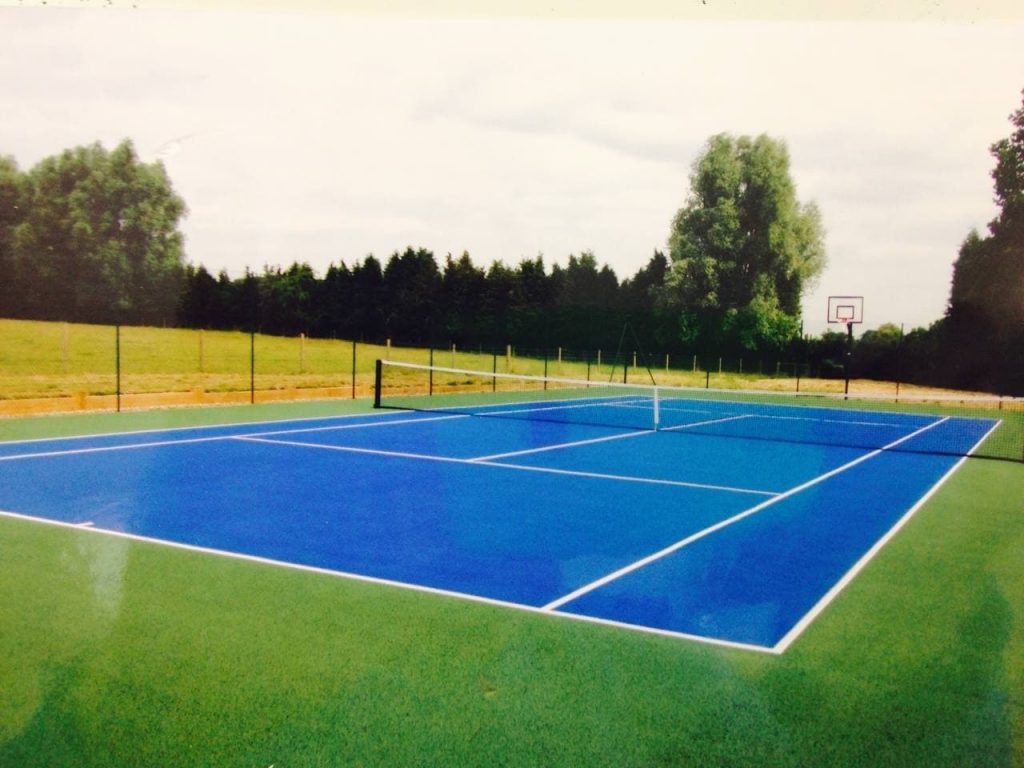
A site survey is one of the most important stages of tennis court construction. It determines whether the proposed area can support a stable, well-drained and practical court before excavation and installation begin.
Even a large, apparently level area may contain slopes, weak ground, restricted access or drainage problems that are not immediately obvious. Identifying these factors at the beginning allows the court to be designed around the actual site conditions rather than relying on assumptions that may cause difficulties later.
What Does a Tennis Court Site Survey Assess?
A professional site survey examines the proposed court location, surrounding land and practical requirements of the project. The findings inform the layout, ground preparation, drainage, surface construction and supporting features.
The survey should establish not only whether a court can fit within the available space, but whether it can perform reliably once constructed.
Available Space and Court Position
Accurate measurements are essential. The overall construction area must accommodate the playing surface and sufficient surrounding run-off space while allowing room for fencing, gates and maintenance access.
A survey records boundaries, changes in width and nearby features that could affect the layout. These may include:
- Buildings
- Walls and fences
- Trees and planting
- Paths and access routes
- Changes in ground level
- Existing drainage features
- Utility covers
- Retaining structures
This information helps position the court efficiently without creating awkward or unusable spaces around its edges.
Ground Levels and Slopes
A tennis court must appear level to players, but it requires precise gradients to move surface water away. The natural slope of the land therefore has a major influence on the construction work.
Detailed level measurements help determine:
- How much excavation will be required
- Whether material must be removed or redistributed
- How the finished court will sit within the surroundings
- Where retaining support may be needed
- Which direction water should drain
- How paths and entrances will connect to the court
Without accurate level information, the finished surface may contain low points, inconsistent falls or difficult transitions at gates and access areas.
Ground and Subsoil Conditions
The stability of a tennis court depends heavily on the ground beneath it. Soft, disturbed or moisture-sensitive soils may move under load, creating settlement or surface cracking.
A site survey helps assess whether the proposed area contains:
- Firm natural ground
- Made-up or previously disturbed land
- Soft or saturated sections
- Areas affected by poor drainage
- Variable ground conditions
- Roots or organic material
- Evidence of previous settlement
The findings influence the excavation depth, sub-base design and any additional measures needed to create a dependable foundation.
Drainage Requirements
Effective drainage is fundamental to the long-term performance of an outdoor tennis court. Water that remains on or beneath the surface can affect play, weaken supporting layers and contribute to premature deterioration.
A site survey considers how water currently moves across the land and where it can be directed after construction. This includes reviewing natural falls, surrounding surfaces and potential collection points.
A suitable drainage design may incorporate:
- Carefully formed surface gradients
- Perimeter drainage
- Drainage channels
- Free-draining foundation layers
- Suitable discharge routes
- Protection against water flowing onto the court from higher ground
Planning these elements before construction is far more effective than trying to correct persistent standing water afterwards.
Construction Access
Tennis court construction involves excavation machinery, deliveries and the movement of substantial quantities of material. The survey must therefore consider how workers, vehicles and equipment will reach the site.
Restricted access may influence the machinery used, the sequence of operations and how materials are delivered. Gate widths, narrow routes, soft ground, overhead obstructions and sharp turns should all be considered.
Planning access carefully helps the project proceed efficiently while reducing unnecessary disturbance to the surrounding property.
Trees, Roots and Vegetation
Nearby trees can influence both construction and future court performance. Roots may extend into the proposed foundation area, while overhanging branches can deposit leaves and organic debris onto the surface.
A site survey should assess the position and likely influence of established vegetation. This helps determine whether the court layout should be adjusted and whether root-related movement or drainage obstruction may become a concern.
The assessment should consider the wider growing environment rather than focusing only on vegetation visible within the court footprint.
Court Orientation and Playing Conditions
The court’s position should take account of how players will experience sunlight, wind and surrounding shade. Poor orientation can make play uncomfortable at particular times of day, while excessive shade may slow surface drying.
A survey allows these conditions to be considered alongside the physical restrictions of the site. The best position is usually one that balances playing comfort, practical construction and efficient use of the available land.
Choosing the Most Suitable Court Surface
Different tennis court surfaces place different demands on the foundation and drainage system. The site survey provides the technical information needed to select and design a suitable construction.
The intended level of use should also be considered. A private court used occasionally may have different operational requirements from a facility receiving frequent play, although both still require stable foundations and accurate drainage.
Surface selection should therefore follow the site assessment rather than being treated as a purely visual decision.
Fencing, Gates and Additional Features
Perimeter fencing needs secure foundations and sufficient space around the playing area. Gate positions must also connect conveniently with surrounding paths without interfering with play.
If lighting, practice walls or other features are being considered, their location should be incorporated into the initial design. Planning the complete facility together helps avoid conflicts between drainage, fencing, access and court equipment.
Identifying Problems Before Work Begins
One of the main benefits of a site survey is that it exposes potential difficulties while the design can still be adjusted. Common issues may include:
- Insufficient space for the intended layout
- Unexpected changes in level
- Weak or waterlogged ground
- Restricted machinery access
- Water flowing towards the proposed court
- Trees affecting the foundation area
- Poorly positioned entrances
- Conflicts between fencing and nearby features
Finding these constraints early allows an appropriate construction strategy to be developed. This supports better decision-making and reduces the likelihood of avoidable changes during installation.
Turning Survey Findings into a Construction Plan
The survey should lead to a site-specific plan covering excavation, foundation depths, drainage, finished levels, surfacing and perimeter details.
This information gives the construction team a clear understanding of how the court should be built. It also ensures that different elements work together rather than being designed separately.
A professional survey adds value because it connects the client’s aims with the site’s practical conditions. The result should be a court that fits the property, drains correctly and provides a consistent playing surface.
Conclusion
A site survey is essential before tennis court construction because it establishes whether the proposed location is suitable and how the court should be designed. Space, levels, ground conditions, drainage, access and surrounding features all influence the finished result.
Careful assessment before excavation supports a stable foundation and helps prevent avoidable performance problems. If you are considering a new court in Portsmouth, UK, Tennis Court Construction Portsmouth can assess the site and develop an appropriate construction plan. Contact the team to arrange a professional site survey.
Call us on: 023 9431 1394
Click here to find out more about Tennis Court Construction Portsmouth
Click here to complete our contact form and see how we can help with your courts needs.