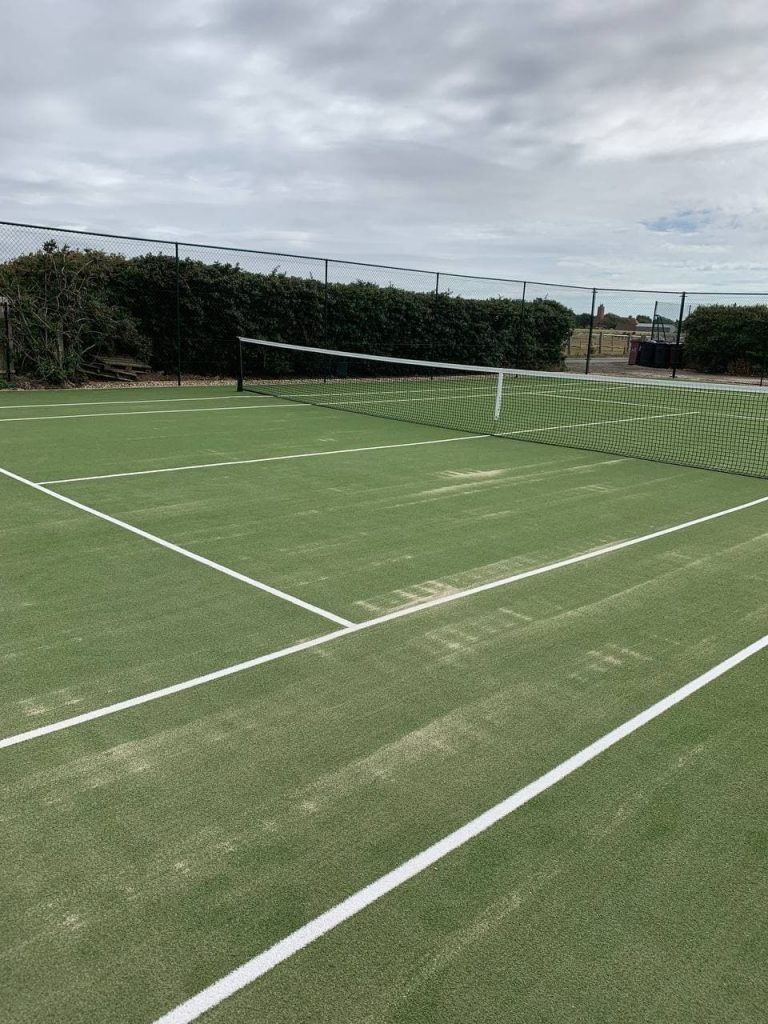
A newly constructed tennis court should provide a consistent, stable and dependable playing surface. When cracking, unevenness, standing water or premature surface deterioration begins appearing relatively soon after construction, the visible defect is often only part of the problem. In many cases, the underlying cause can be traced back to preparation, drainage, construction or the relationship between the different layers beneath the finished court.
For tennis courts in Portsmouth, understanding these causes is important because repairing the surface without identifying why it has deteriorated may result in the same problem returning. At Tennis Court Construction Portsmouth, careful attention to the complete court construction is essential for creating a surface designed for dependable long-term performance.
Why Can a New Tennis Court Develop Problems So Soon?
The finished playing surface represents only the upper part of a tennis court.
Its performance depends heavily on the construction underneath. If weaknesses exist within the ground preparation, sub-base, drainage or surfacing layers, they can eventually become visible at surface level.
Early problems can include:
- Cracking
- Localised sinking
- Uneven areas
- Standing water
- Surface movement
- Premature wear
- Poor consistency across the playing area
- Deterioration around court edges
When these appear on a relatively new court, the cause should be investigated rather than simply treating the visible symptom.
Inadequate Ground Preparation Can Affect the Entire Court
Good tennis court construction begins with the site itself.
The ground needs to provide suitable support for the construction above. If unsuitable or unstable material remains beneath the court, movement can occur after installation.
Even relatively small changes underneath can become noticeable across a large, precisely finished playing surface.
Professional site preparation therefore provides the foundation for everything that follows. The finished court cannot compensate indefinitely for instability beneath it.
Poor Compaction Can Lead to Settlement
The supporting materials beneath a tennis court need to be properly placed and compacted.
Where compaction is inconsistent, some sections may settle more than others once the court is in use and exposed to changing conditions.
This can lead to:
- Low spots
- Surface depressions
- Uneven playing areas
- Cracking between stable and moving sections
- Changes in drainage falls
A court may initially appear satisfactory immediately after construction, with settlement only becoming apparent later.
This is why thorough preparation before surfacing is so important.
The Sub-Base Is Critical to Long-Term Performance
The sub-base provides essential structural support beneath the playing surface.
Its role is to create a stable and consistent foundation capable of supporting the layers above. If it is unsuitable, poorly constructed or unevenly compacted, the finished surface can eventually reflect those weaknesses.
A good sub-base helps distribute loads and maintain consistent levels across the court.
Problems within this layer cannot always be solved effectively by applying additional material to the surface.
Drainage Problems Can Quickly Become Visible
Water management is a fundamental part of outdoor tennis court construction.
The finished surface needs suitable levels and falls so that rainfall can move away appropriately. The wider construction also needs to prevent water from creating unnecessary problems around or beneath the court.
Poor drainage can result in persistent puddling and prolonged wet areas.
If water repeatedly remains in particular sections after surrounding areas have drained, the surface levels and underlying construction should be assessed.
Low Spots Can Cause Standing Water
Even relatively small variations in levels can become noticeable after rainfall.
A depression that appears insignificant when the court is dry may collect water during wet weather.
Standing water can interfere with court availability and highlight inconsistencies in the finished surface.
Where low spots develop after construction, it is important to establish whether they resulted from inaccurate surface levels or subsequent settlement beneath the court.
The repair approach may be different depending on the cause.
Cracks Can Be a Symptom of Movement Below
Surface cracking is one of the most obvious signs that a tennis court has developed a problem.
However, the crack itself does not always identify the root cause.
Cracking can occur where different parts of the construction move independently. If the underlying layers continue moving, repairing only the visible crack may provide a temporary improvement rather than a lasting solution.
The pattern of cracking can provide useful information. One isolated defect may have a local cause, while cracks developing across several sections can indicate a broader issue requiring investigation.
Surface Materials Need a Stable Foundation
Regardless of the selected court finish, the surface depends on the construction beneath it.
A professionally applied surface cannot perform as intended if its supporting layers are unstable or incorrectly prepared.
This is why tennis court construction should be viewed as a complete system rather than a surfacing project alone.
The quality of the finished playing area is closely connected with work that becomes invisible once construction is completed.
Incorrect Surface Preparation Can Affect Adhesion and Finish
Before finishing materials are applied, the underlying surface needs to be suitable for the system being installed.
Contamination, excessive moisture, unsuitable surface conditions or inadequate preparation can affect how successfully the finished layers perform.
Problems may become visible as localised deterioration or areas where the surface behaves differently from the rest of the court.
Professional construction involves following the appropriate preparation process at every stage rather than relying on the final coating to hide inconsistencies underneath.
Rushing Between Construction Stages Can Create Problems
Different stages of court construction need to be completed in the correct sequence and under suitable conditions.
Installing subsequent layers before earlier work is ready can affect the finished result.
Tennis court construction therefore requires careful planning. The objective should not simply be to reach the finished surface as quickly as possible, but to ensure each stage provides a suitable foundation for the next.
Good long-term performance begins with disciplined construction from the ground upwards.
Weather Conditions Can Influence Surfacing Work
Outdoor tennis court construction is naturally affected by weather conditions.
Rainfall, surface moisture and temperature can influence certain stages of preparation and surfacing. Attempting work when conditions are unsuitable can compromise the quality of the finished result.
Professional contractors need to take prevailing conditions into account and plan the work accordingly.
This is particularly important for the final stages, where achieving a consistent finish across a large playing area requires careful control.
Court Edges Need Proper Construction
The perimeter of the court can sometimes receive less attention than the central playing area, but stable edges are important.
Weaknesses around the perimeter can allow movement or deterioration to begin at the boundaries and gradually affect nearby surfacing.
Court edges should integrate properly with the surrounding construction so that the finished surface remains supported.
Where deterioration repeatedly begins around the perimeter, the condition beneath and alongside the surface should be investigated.
Surrounding Ground Can Affect the Court
A tennis court does not exist independently from the site around it.
Water movement, ground conditions and surrounding levels can all influence how the court performs.
If rainfall from neighbouring areas is allowed to flow towards the court, for example, the drainage system may have to deal with additional water that should have been managed elsewhere.
Good construction therefore considers the complete site rather than only the dimensions of the playing area.
Why Consistent Levels Matter So Much
Tennis courts require a much higher degree of surface consistency than many ordinary outdoor hard surfaces.
Players need predictable footing and reliable ball behaviour across the court.
Even relatively modest irregularities can become noticeable during play.
Accurate preparation and levelling throughout construction therefore contribute directly to both the practical performance and quality of the completed court.
Premature Surface Wear Can Have Several Causes
A new tennis court should not begin looking heavily deteriorated after a relatively short period of normal use.
Where premature wear develops, it is important to consider more than the upper surface.
Possible contributing factors can include unsuitable preparation, inconsistent construction, drainage issues or movement beneath the finished layers.
The location of the deterioration can provide useful clues. Wear confined to one specific area may have a different cause from deterioration appearing across much of the court.
Why Simply Resurfacing May Not Solve the Problem
When a tennis court looks worn or cracked, resurfacing can appear to be the obvious solution.
However, resurfacing is most effective when the supporting construction remains stable.
If cracking is caused by movement below the surface, placing a new finish over the existing court may not prevent the defect from eventually reappearing.
Before resurfacing a problematic court, the underlying condition should therefore be assessed.
The objective is to determine whether the issue is superficial or structural within the wider court construction.
Some Problems Can Remain Localised
Not every defect on a recently constructed tennis court indicates widespread failure.
A small isolated area may be repairable where:
- Surrounding construction remains stable
- Drainage performs correctly
- Movement is confined to one location
- The cause can be clearly identified
- The wider playing surface remains consistent
In these circumstances, targeted repair may restore the affected section without unnecessary work elsewhere.
When Do Several Defects Suggest a Wider Problem?
More comprehensive investigation becomes particularly important when several different symptoms develop together.
For example, a court experiencing cracking, low spots and standing water across multiple sections may have a broader construction issue rather than several unrelated surface defects.
Warning signs can include:
- Cracks returning after previous repairs
- Several areas becoming uneven
- Widespread surface deterioration
- Multiple drainage problems
- Movement around the court perimeter
- Increasing numbers of low spots
At this stage, understanding the underlying construction becomes essential before further work is planned.
Good Tennis Court Construction Starts Below the Surface
The appearance of a newly completed tennis court is important, but the parts that cannot be seen are equally significant.
Professional construction should give careful attention to:
- Existing ground conditions
- Site preparation
- Excavation
- Sub-base construction
- Compaction
- Drainage
- Finished levels and falls
- Edge stability
- Surface preparation
- Final surfacing
Each stage influences the next.
A strong, consistent foundation provides the best basis for creating a high-quality playing surface that continues performing as intended.
Why Professional Construction Makes a Difference
Tennis court construction requires considerably more than creating a flat area and applying a sports surface.
The court needs to perform consistently across a substantial area while dealing with regular use and outdoor conditions.
At Tennis Court Construction Portsmouth, we provide professional tennis court construction services throughout Portsmouth, with careful attention to the preparation and supporting construction beneath the finished playing surface.
By considering drainage, levels, structural preparation and surfacing as parts of the same system, the aim is to reduce avoidable problems and create a dependable court designed around long-term use.
Conclusion
Newly built tennis courts can develop surface problems when weaknesses exist within ground preparation, compaction, the sub-base, drainage, levels or the installation of the finished surface. Cracking, low spots, standing water and premature deterioration should therefore be treated as potential symptoms rather than automatically assumed to be isolated surface defects.
The most dependable tennis courts begin with careful preparation below ground level and continue through every stage of construction. Where a new or relatively recent court develops problems, identifying the underlying cause is essential before deciding whether localised repairs, resurfacing or more extensive corrective work is appropriate.
If your tennis court in Portsmouth is showing unexpected cracking, unevenness, drainage issues or premature surface deterioration, Tennis Court Construction Portsmouth can assess its condition and determine the most suitable approach. Contact our team to discuss professional tennis court construction, repairs or refurbishment focused on creating a stable and consistent playing surface.
Call us on: 023 9431 1394
Click here to find out more about Tennis Court Construction Portsmouth
Click here to complete our contact form and see how we can help with your courts needs.